Welcome to the Department of Electronics and Communication Engineering Established in 2007.
Electronics and Communication Engineering is one of the most dynamic and rapidly evolving fields that drives modern technological advancements. Our department is committed to providing high-quality education, fostering innovation, and developing technically competent engineers who can contribute effectively to society and the global technological landscape.
We focus on building strong fundamentals in electronics, communication systems, signal processing, embedded systems, and emerging technologies while encouraging research, creativity, and problem-solving abilities among our students. Our dedicated faculty members strive to create an engaging learning environment through a combination of theoretical knowledge, practical exposure, and industry-oriented activities.
The department is equipped with well-established laboratories and modern facilities to support academic learning, research, and innovation. We also emphasize industry interaction, internships, workshops, and technical activities to prepare students for real-world challenges.
Our goal is not only to produce skilled engineers but also responsible professionals with strong ethical values, leadership qualities, and a commitment to lifelong learning.
I invite you to explore our department and join us in our journey of knowledge, innovation, and excellence.
Best wishes,
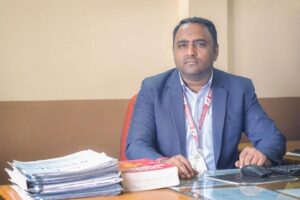
Dr. Deepak Kourav
Head of the Department
Department of Electronics and Communication Engineering
| NAME | Photo | Desig- nation | Date of Joining | Edu- cation Quali-fication | Contact No. | Area Of Interest | |
| Dr. Deepak Kourav | 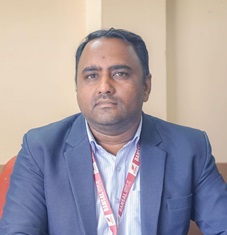 | Professor | 16/08/ 2022 | P.hd | 90748 07291 | deepkourav @gmail.com | Signal System, Digital Signal Processing, Digital Communi- cation |
| Dr. Dheeraj Kumar | 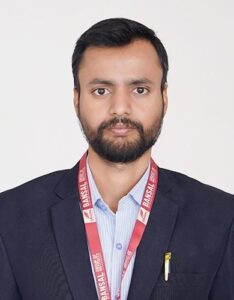 | Associate Professor | 9/9/ 2024 | P.hd | 89622 66497 | dheerajkumarsr @gmail.com | Electronics Measurement Instrumentation, Antenna & Wave Propagation, Control System, |
| Prof. Sumit Soni | 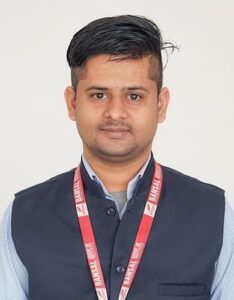 | Assistant Professor | 10/7/ 2021 | M.tech | 78982 76714 | sumitsoni.bist @gmail.com | Electronic Device & Circuit, Analog Communication |
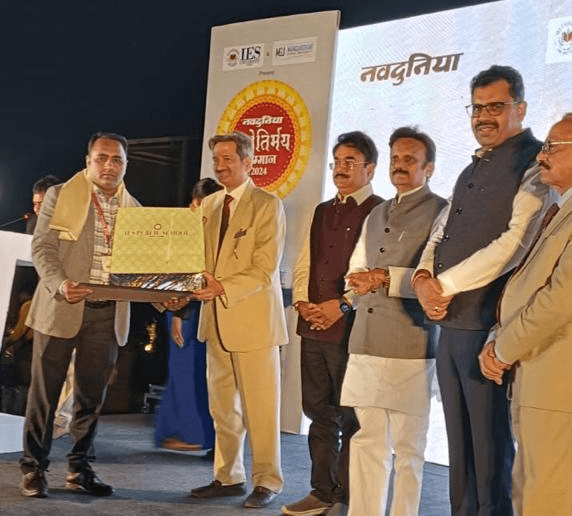
Dr. Deepak Kourav has been awarded with Jyotirmay Samman 2024 .This event was sponsored by Nav Duniya and was given for 19 years of dedication in the field of teaching engineering students.
| S.NO | Name of Faculty | Designation | Achievement | Title/Details of Achievement | organization | Date |
1. |
Dr. Dheeraj Kumar |
Associate Professor |
ATAL FDP | Emerging Trends in Antenna and RF Design for Next Gen Communication |
LNCTS Bhopal |
Aug 04-06 2025 |
2. |
Dr. Dheeraj Kumar |
Associate Professor |
Patent | AI based Reconfigurable Antenna for Adaptive Wireless Signal Optimization |
U K Design |
18/12/2025 |
3. |
Dr. Dheeraj Kumar |
Associate Professor |
STTP |
Trends in RF Devices, Antennas and RADAR System |
MANIT Bhopal |
15-19 Dec 2025
|
4. |
Prof. Sumit Soni |
Assistant Professor |
STTP |
Trends in RF Devices, Antennas and RADAR System |
MANIT Bhopal |
15-19 Dec 2025
|
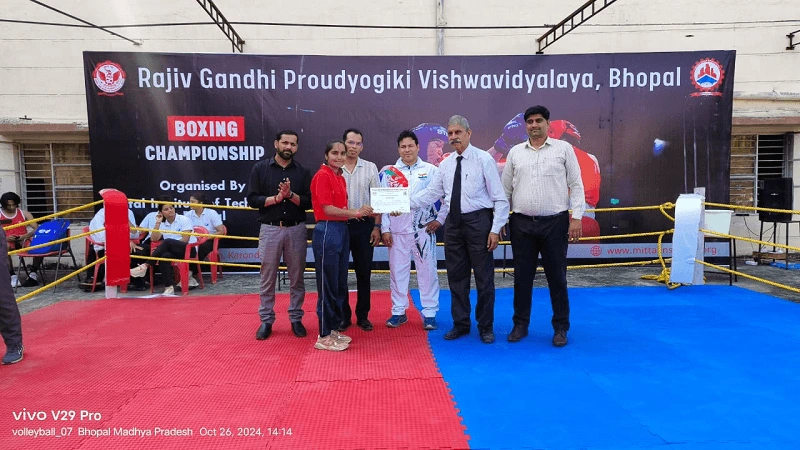
RGPV Boxing Championship 2024
The Department of Electronics & Communication Engineering proudly congratulates Ms. Prachi Lodhi for her outstanding achievement in the RGPV Boxing Championship 2024, where she emerged as the Winner.
Her remarkable performance, determination, and sportsmanship have brought pride and recognition to the Department and the Institute. This achievement reflects her dedication, discipline, and perseverance, inspiring fellow students to strive for excellence in both academics and extracurricular activities.
The Department applauds Ms. Prachi Lodhi for this exceptional accomplishment and wishes her continued success in her future sporting and academic endeavors.
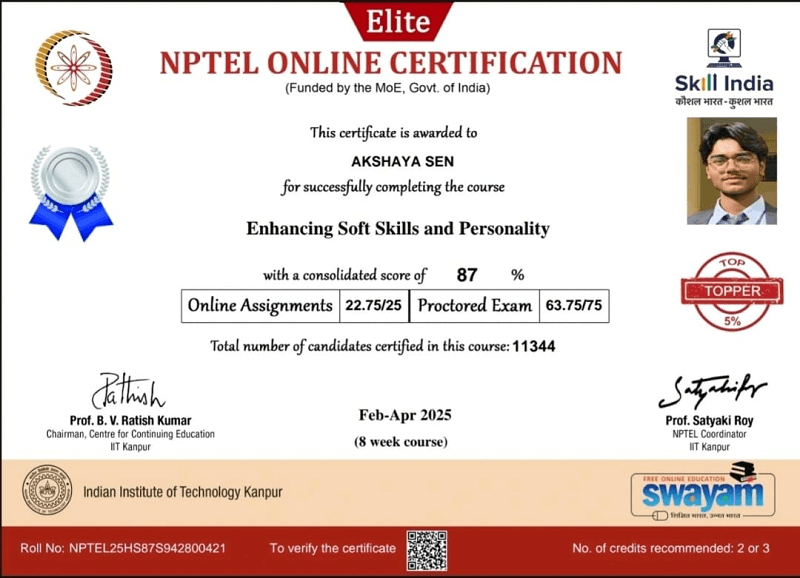
NPTEL Elite Certification Achievement
The Department of Electronics & Communication Engineering proudly congratulates Mr. Akshaya Sen for successfully completing the NPTEL Online Certification Course titled “Enhancing Soft Skills and Personality.”
This certification reflects his commitment to holistic personal and professional development. Through this course, he has enhanced essential skills in communication, leadership, teamwork, time management, interpersonal relations, problem-solving, and professional ethics, which are vital for academic excellence and career success.
The Department appreciates his dedication to continuous learning and personality development and wishes him continued success in his academic, professional, and future endeavors.
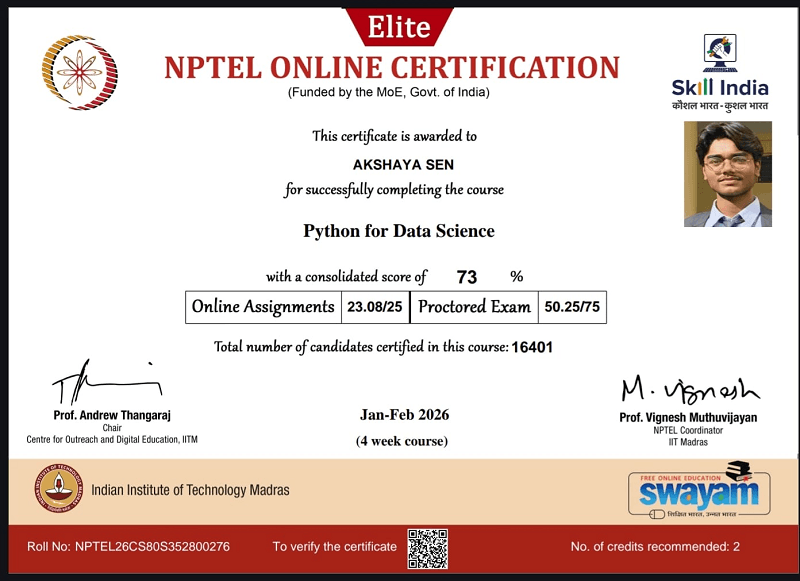
The Department of Electronics & Communication Engineering proudly congratulates Mr. Akshaya Sen for successfully completing the NPTEL Online Certification Course titled “Python for Data Science.”
This certification demonstrates his commitment to strengthening his knowledge in Python programming, data analysis, and modern data science techniques. Through this course, he has developed valuable skills in data handling, visualization, and computational problem-solving, which are highly relevant to emerging technologies such as Artificial Intelligence, Machine Learning, and Data Analytics.
The Department appreciates his dedication towards continuous learning and professional development and wishes him continued success in his academic, research, and future career endeavors.
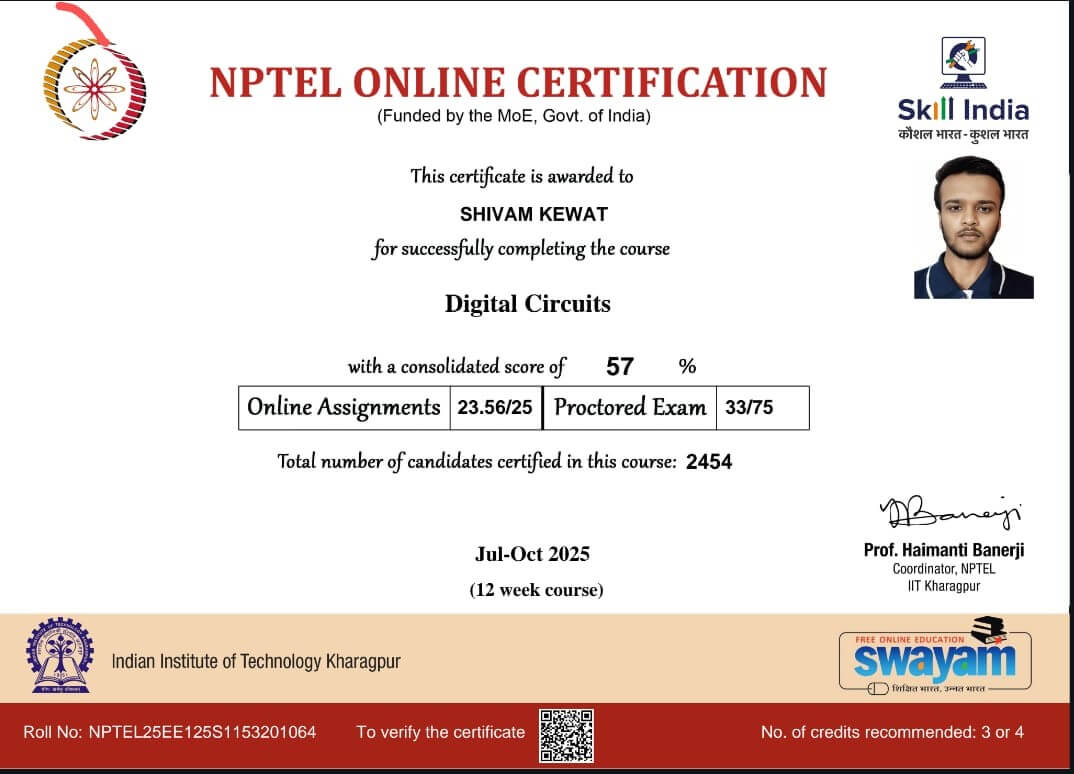
NPTEL Certification Achievement
The Department of Electronics & Communication Engineering proudly congratulates Mr. Shivam Kewat for successfully completing the NPTEL Online Certification Course titled “Digital Circuits.”
This certification reflects his dedication to enhancing his knowledge of digital electronics and logical circuit design. Through this course, he gained a strong understanding of combinational and sequential circuits, Boolean algebra, logic gates, flip-flops, counters, registers, and the fundamentals of digital system design.
The Department appreciates his commitment to academic excellence and continuous learning and wishes him continued success in his future academic, research, and professional endeavors.
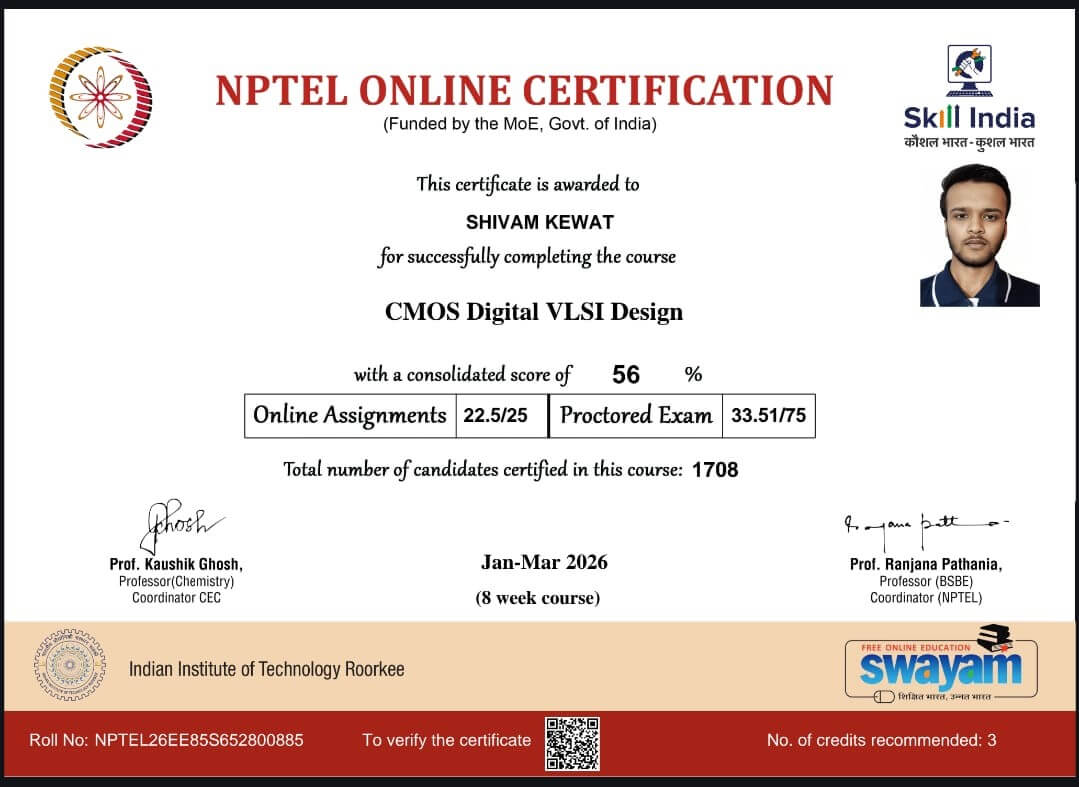
The Department of Electronics & Communication Engineering proudly congratulates Mr. Shivam Kewat for successfully completing the NPTEL Online Certification Course titled “CMOS Digital VLSI Design.”
This certification highlights his commitment to advancing his knowledge in VLSI system design and semiconductor technology. Through this course, he acquired a strong understanding of CMOS fabrication technology, MOS transistor operation, CMOS logic design, combinational and sequential VLSI circuits, timing analysis, power optimization, and digital integrated circuit design principles.
The Department appreciates his dedication to continuous learning and technical excellence and wishes him continued success in his academic, research, and professional journey.
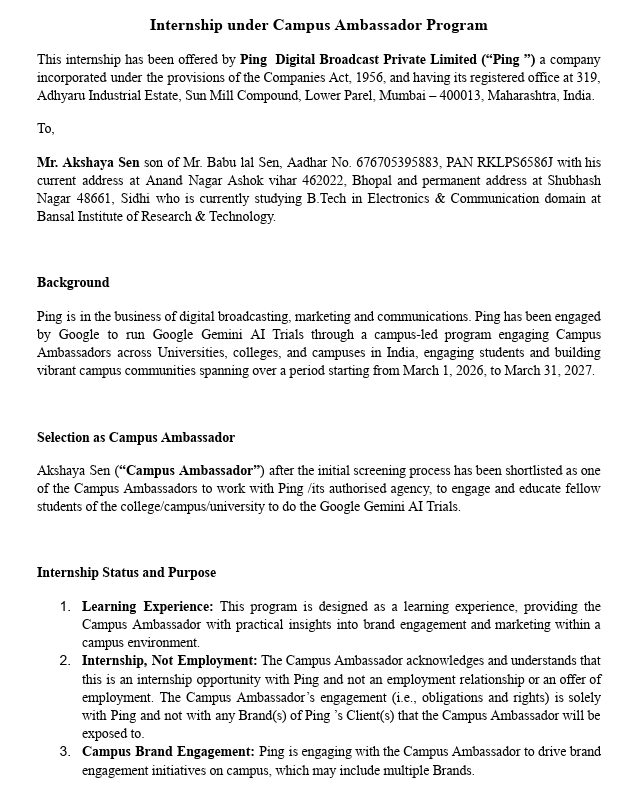
Internship under Campus Ambassador Program
Ping Digital Broadcast Private Limited
The Department of Electronics & Communication Engineering proudly congratulates Mr. Akshaya Sen for successfully completing an Internship under the Campus Ambassador Program at Ping Digital Broadcast Private Limited.
During the internship, he demonstrated enthusiasm, professionalism, and effective communication while representing the organization as a Campus Ambassador. This experience enabled him to develop valuable skills in leadership, networking, brand promotion, event coordination, and professional communication, contributing significantly to his overall personality and career development.
The Department appreciates his dedication to experiential learning and congratulates him on this noteworthy achievement. We wish him continued success in his academic, professional, and future career endeavors.
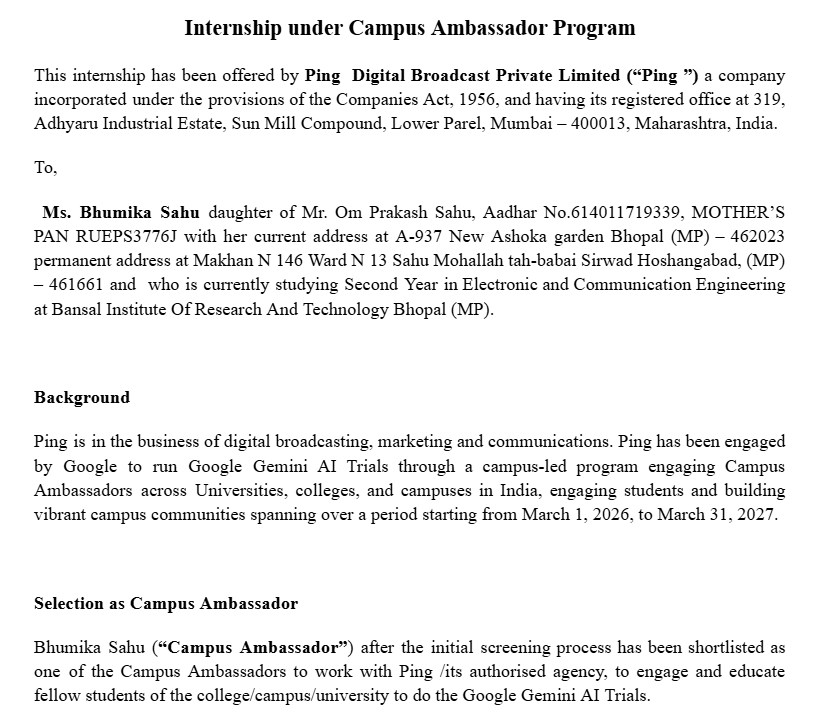
The Department of Electronics & Communication Engineering proudly congratulates Ms. Bhumika Sahu for successfully completing an Internship under the Campus Ambassador Program at Ping Digital Broadcast Private Limited.
During the internship, she demonstrated enthusiasm, professionalism, and effective communication while representing the organization as a Campus Ambassador. This experience enabled her to develop valuable skills in leadership, networking, brand promotion, event coordination, and professional communication, contributing significantly to her overall personality and career development.
The Department appreciates her dedication to experiential learning and congratulates her on this noteworthy achievement. We wish her continued success in her academic, professional, and future career endeavors.
Report on One Day Seminar
1. Title of the Program
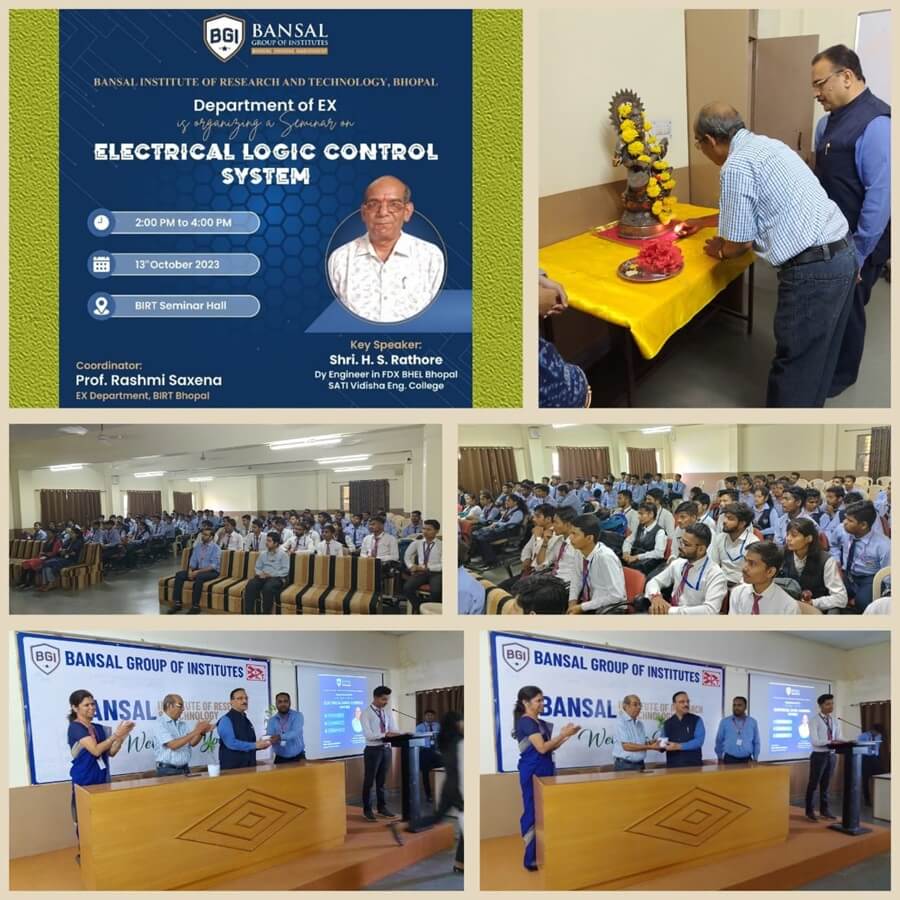
One Day Seminar on Electrical Logic Control System
2. Organizing Department
Department of Electronics and Communication Engineering & Department of Electrical and Electronics Engineering
3. Date of the Program
13 October 2023
4. Resource Person
Shri H. S. Rathore
(Dy. Engineer, FDX BHEL Bhopal & SATI Vidisha College)
5. Duration
One Day
6. Number of Participants
75 Students
7. Objectives of the Program
The main objectives of the seminar program were:
- To control and automate electrical machines and processes using logical operations.
- To ensure safe and reliable operation of industrial equipment.
- To improve efficiency, accuracy, and productivity of systems.
- To implement logical decision-making using relays, contactors, PLCs, and sensors.
- To facilitate easy troubleshooting and maintenance.
- To support flexible and scalable automation solutions.
8. Brief Description of the Program
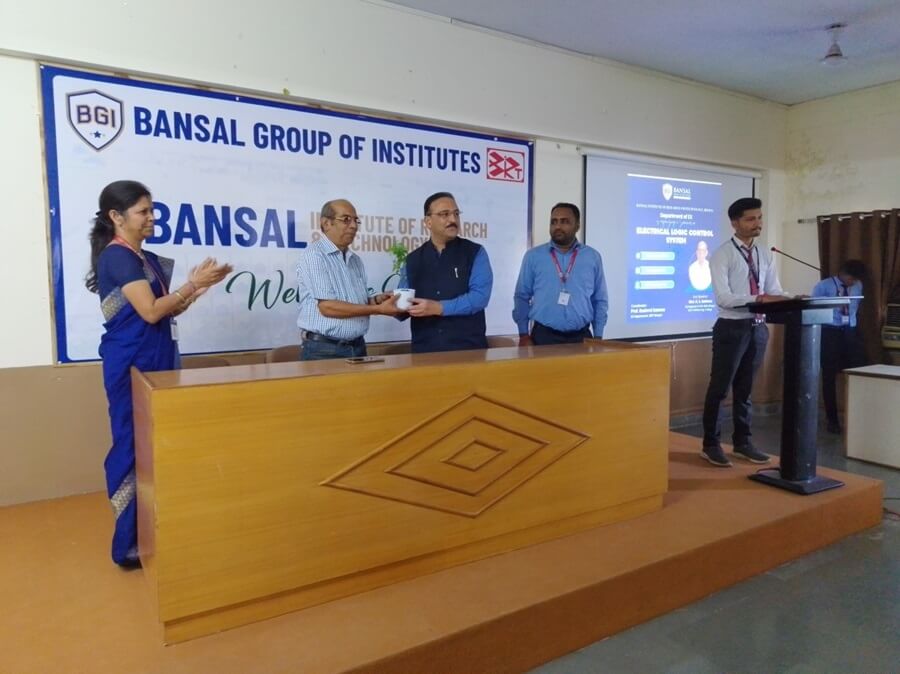
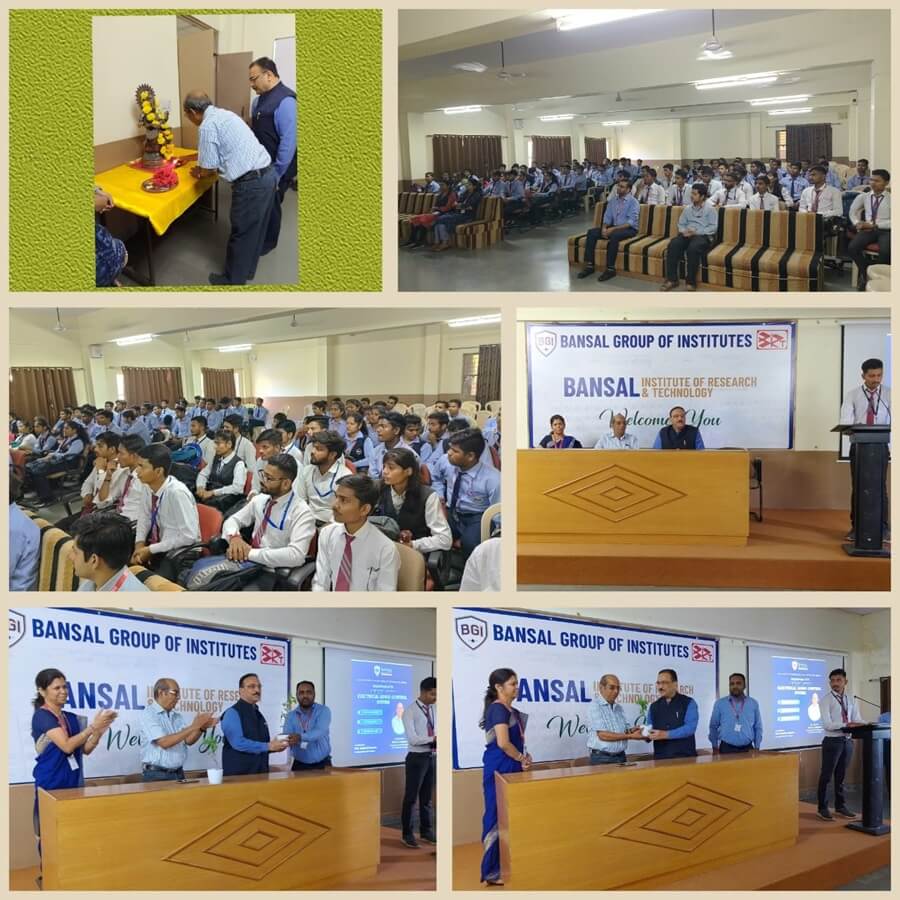
A One Day Seminar on Electrical Logic Control System was organized by the Department of Electronics and Communication Engineering and the Department of Electrical and Electronics Engineering on 13 October 2023.
The seminar focused on the design and operation of electrical logic control systems used in industrial automation. The resource person explained how electrical machines and industrial processes are controlled using predefined logical conditions.
The session covered various components such as relays, contactors, timers, sensors, and Programmable Logic Controllers (PLCs), which are used to perform logical functions like AND, OR, and NOT operations.
The seminar also highlighted the importance of automation in ensuring safe, sequential, and efficient operation of industrial equipment. The program provided students with practical knowledge about industrial control systems and enhanced their understanding of automation technologies used in modern industries.
9. Outcomes of the Program
After successful completion of the seminar program, the following outcomes were achieved:
- Reliable and automatic control of electrical machines and processes.
- Improved safety through interlocking and protection circuits.
- Reduction in human error and manual intervention.
- Higher efficiency and productivity in industrial operations.
- Accurate and sequential operation of control systems.
- Easy troubleshooting and maintenance of electrical systems.
- Better energy management and system reliability.
- Foundation for advanced automation and PLC-based systems.
10. Coordinator
The seminar was successfully coordinated by:
- Prof. Rashmi Saxena
Their dedicated efforts ensured the smooth planning and successful execution of the program.